Manufacturing ransomware protection stops production-halting attacks before encryption by combining continuous OT asset visibility, configuration change detection, and protocol-aware monitoring that IT security tools cannot deliver on the factory floor.
Attackers go where downtime hurts most. Your plants run PLCs, HMIs, drives, and robotics from multiple vendors, much of it on legacy systems you can't patch without stopping the line.
That mix of aging assets, flat networks, and overlapping standards like IEC 62443, NIST 800-82, and CMMC makes it nearly impossible to maintain a current, accurate picture of your OT environment.
You're the #1 target on the board, and you're expected to prove security and compliance across assets you can't always see.

You're responsible for compliance you can't fully prove, and risk you can't fully see.
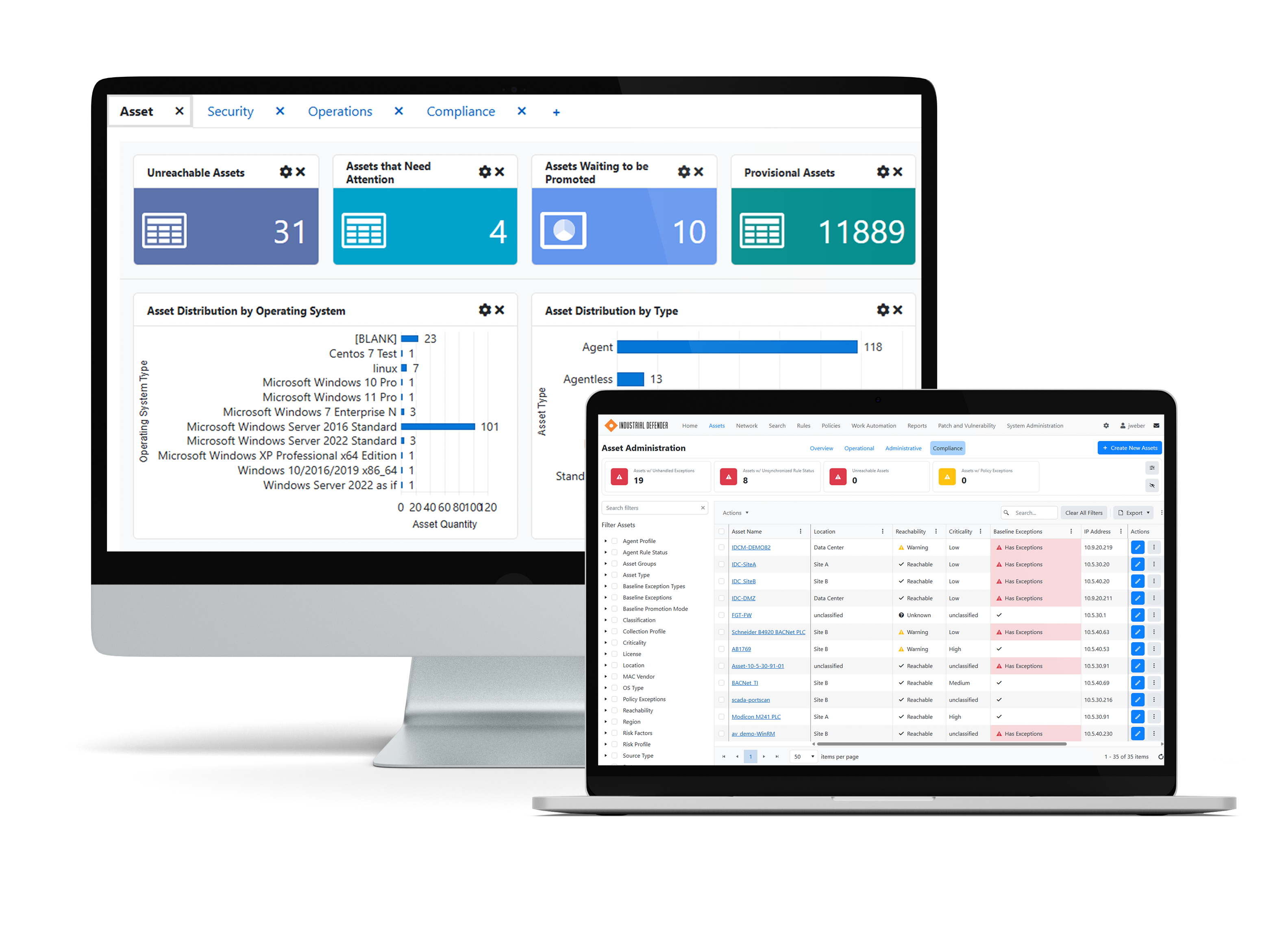
Industrial Defender provides a single, unified view of your OT environment, enabling teams to continuously monitor assets, detect risks, and generate compliance-ready reports aligned to NIS2 and IEC standards.

Automatically discover and inventory all assets across your environment
Identify anomalies, vulnerabilities, and configuration changes in real time
Daily updates track changes on devices and network.
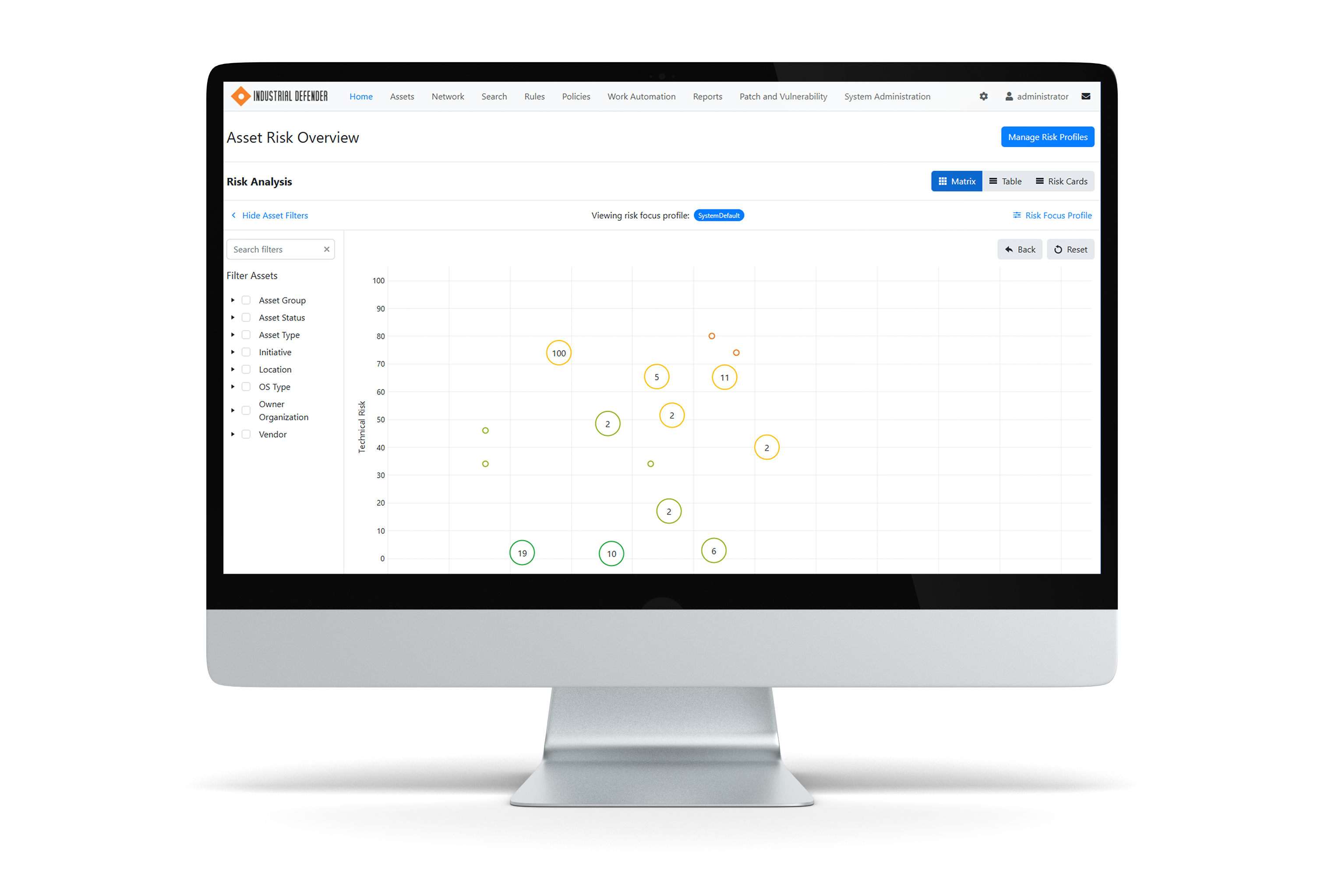
Prioritize what matters most across your infrastructure
The Industrial Defender platform enables organizations to strengthen cybersecurity across multiple domains.

Together, these capabilities created a unified OT cybersecurity platform — delivering continuous visibility, automated monitoring, and audit-ready compliance across the utility's entire operational environment.

Automatically identify and inventory every device, system, and connection across your industrial environment.

Understand your current security state, gaps, and risk exposure relative to compliance requirements.

Detect anomalies, vulnerabilities, and configuration changes across your environment in real time.

Produce documentation automatically, whenever you need it, without manual effort.
.svg)
Ransomware attacks targeting manufacturing rose 56% in 2025, climbing from 937 to 1,466 incidents, making the sector the most targeted industry globally. Three factors converged: operational technology systems designed before cybersecurity existed, supply chain complexity that creates multiple attack vectors, and the explosion of Ransomware-as-a-Service platforms that lowered the technical barrier for attackers.
Half of all 2025 ransomware attacks hit critical sectors, with manufacturing, healthcare, and energy the top global targets, reflecting how attackers prioritize industries where operational disruption creates immediate financial pressure to pay ransoms.
Legacy distributed control systems, SCADA networks, and programmable logic controllers were engineered for reliability and uptime, not security. Many facilities operate industrial control systems installed 15 to 25 years ago when air-gapped networks were considered sufficient protection. Modern smart manufacturing connected these previously isolated OT networks to enterprise IT, cloud platforms, and supplier networks without adequate segmentation or visibility.
The operational impact differs fundamentally from IT. When ransomware encrypts a file server, employees lose access to documents. When ransomware encrypts a distributed control system managing a chemical reactor or automotive assembly line, production stops immediately. The critical manufacturing cybersecurity challenge extends beyond data encryption to physical process disruption, safety system interference, and supply chain cascading failures.
Supply chain complexity multiplies attack surfaces. A single automotive manufacturer connects to hundreds of tier-one suppliers, each with varying security maturity. Attackers compromise smaller suppliers with weaker defenses, then use trusted vendor relationships to reach larger manufacturers.
Endpoint protection and antivirus software designed for corporate networks cannot protect operational technology because they fundamentally misunderstand how industrial control systems operate. Traditional tools assume Windows or Linux endpoints running standard applications with regular patch cycles. Manufacturing OT networks run proprietary real-time operating systems, legacy protocols without encryption, and hardware that cannot be patched or rebooted without production shutdowns.
Protocol-specific vulnerabilities in Modbus, DNP3, OPC, and Ethernet/IP expose networks to attacks IT tools cannot detect. These protocols were designed for closed networks where all devices were trusted. They lack authentication, transmit commands in cleartext, and provide no integrity verification. A distributed control system receiving a Modbus write command has no way to verify whether it came from an authorized human-machine interface or ransomware.
Operational uptime requirements prevent traditional security scanning. Active vulnerability scanning sends probe packets that can cause programmable logic controllers to fault, trip safety systems, or disrupt real-time control loops. The ransomware prevention strategies that work in IT environments, such as regular vulnerability scanning and automated patching, create unacceptable production risk in OT networks.
The air-gap myth persists despite modern realities. Remote access for vendor support creates internet-facing entry points, engineering workstations carry malware between networks, wireless access points provide unauthorized connectivity, and USB drives transfer files between zones. Ransomware enters through IT networks, moves laterally across inadequately segmented zones, and encrypts OT systems before traditional detection triggers alerts.
Configuration management is another critical gap. IT environments expect frequent changes, so IT tools lack the baseline understanding to recognize that a programmable logic controller configuration change is anomalous and potentially indicates ransomware lateral movement.
Get a clear view of your OT environment, your compliance gaps, and how to close them—without risking operations.
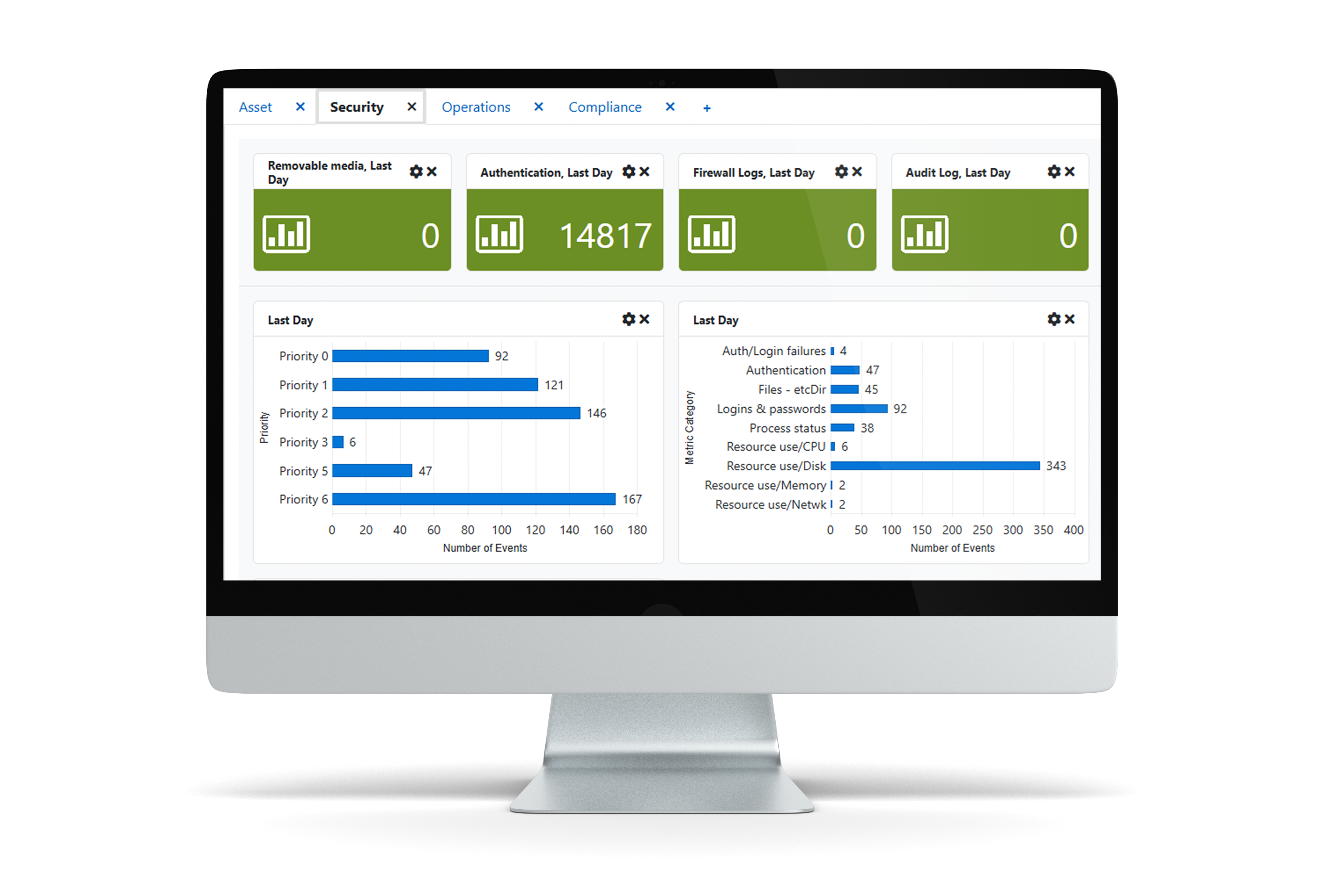
Comprehensive asset visibility provides the foundation for detecting ransomware before encryption occurs. Attackers follow predictable patterns: initial compromise of IT systems, reconnaissance to map OT networks, lateral movement to industrial control systems, and finally payload deployment. Purpose-built protection identifies these early-stage indicators through continuous monitoring of every device, connection, and configuration change.
The OT Asset Management Platform deployed by Industrial Defender provides real-time visibility across 50,000+ OT assets without disrupting production. Active and Passive Monitoring combines network traffic analysis with targeted device queries to build comprehensive inventories of programmable logic controllers, distributed control systems, human-machine interfaces, remote terminal units, and intelligent electronic devices. This hybrid approach captures assets that purely passive monitoring misses while avoiding the production risks of aggressive active scanning.
Configuration change detection identifies ransomware lateral movement by establishing baselines for every industrial control system and alerting on deviations. Ransomware operators modify configurations to disable security controls, create persistence mechanisms, or prepare systems for encryption. Continuous monitoring detects these changes within minutes rather than the days or weeks manual audit processes require.
Baseline anomaly detection extends beyond configuration to network behavior and protocol usage. Manufacturing OT networks exhibit predictable traffic patterns because industrial processes repeat the same control sequences continuously. Ransomware reconnaissance creates anomalies that deviate from these baselines: new device connections, unusual protocol usage, or communication to unexpected IP addresses.
Unauthorized device alerts provide immediate notification when unknown assets appear on OT networks. Ransomware operators frequently deploy staging servers, command-and-control infrastructure, or encryption tools during attack preparation, and these alerts enable teams to investigate and contain threats before payloads deploy.
Ransomware attacks targeting manufacturing rose 56% in 2025, climbing from 937 to 1,466 incidents, making the sector the most targeted industry globally.
Automated configuration tracking across programmable logic controllers, remote terminal units, distributed control systems, and human-machine interfaces provides the technical mechanism for detecting ransomware lateral movement before encryption occurs. Industrial control systems store configurations in proprietary formats, ladder logic programs, and device-specific parameter databases that require protocol-aware interrogation to access.
The shift from manual audits to continuous automated monitoring transformed detection in the Major Chemical Manufacturer case study. Manual processes required engineers to connect to individual controllers, export configurations, and compare files on quarterly or annual schedules, leaving months-long gaps. Automated configuration change management reduced detection time from days to minutes by continuously polling 500+ OT devices and immediately alerting on any deviation from approved baselines.
Ransomware lateral movement creates specific configuration change patterns that automated tracking identifies:
The Industrial Defender Collector deployed across facilities performs continuous configuration polling using native industrial protocols such as Modbus, EtherNet/IP, and PROFINET to retrieve ladder logic, tag databases, and device parameters. This protocol-aware approach avoids the production disruption risks of file-level monitoring.
Configuration baselines established during deployment provide the reference point for detecting unauthorized changes, and rollback capabilities enable rapid recovery when ransomware modifies configurations. Validated configurations can be redeployed to controllers within minutes rather than the hours or days required to rebuild programs from documentation.
Ransomware targeting manufacturing OT systems exploits industrial protocol vulnerabilities in Modbus, DNP3, and OPC communications that lack authentication and encryption. Attackers modify programmable logic controller configurations, disrupt distributed control system operations, and encrypt human-machine interfaces to halt production immediately.
Unlike IT ransomware that encrypts files for data extortion, manufacturing ransomware creates operational disruption that forces rapid ransom payment to restore production and avoid supply chain cascading failures.
Purpose-built OT security platforms deploy ransomware protection without production disruption through passive network monitoring combined with carefully controlled active queries during planned maintenance windows. The Industrial Defender Collector uses native industrial protocols to retrieve configuration data without impacting real-time control loops or introducing latency.
Deployment occurs incrementally across production zones with validation testing to ensure operational safety before expanding coverage.
Air-gapped manufacturing systems face ransomware risk through USB drives, engineering workstations that move between networks, vendor remote access connections, and wireless devices that create unintended connectivity. Industrial Defender Reach provides agentless assessment capabilities for air-gapped environments through portable collectors that perform local asset discovery and configuration analysis without requiring permanent installation or internet connectivity.
Results transfer to centralized platforms via encrypted removable media for analysis and reporting.
OT ransomware protection platforms integrate with existing IT security infrastructure through REST APIs, syslog forwarding, and SNMP traps that feed industrial control system security events into security information and event management platforms and security operations center workflows. This integration enables unified incident response when ransomware compromises IT networks and attempts lateral movement into OT environments.
The platforms maintain independent operation to ensure OT visibility continues even if IT security tools fail during ransomware incidents.
Manufacturing ransomware protection aligns with NIST CSF through automated asset identification, protective controls enforcement, continuous detection monitoring, incident response capabilities, and recovery planning support. IEC 62443 alignment occurs through security level controls including access management, configuration change detection, and protocol-aware monitoring that satisfy Security Level 2 and 3 requirements.
The Compliance Reporting Engine automatically collects evidence demonstrating framework implementation and generates audit-ready reports that reduce compliance preparation time by 60%.


